
Agenta vs diffray
Side-by-side comparison to help you choose the right product.

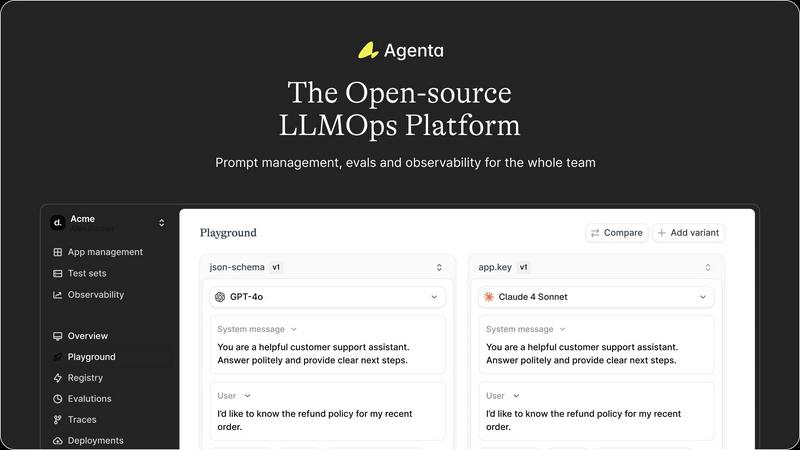
Agenta is the open-source LLMOps platform that helps teams build reliable AI apps together.
Last updated: March 1, 2026

diffray
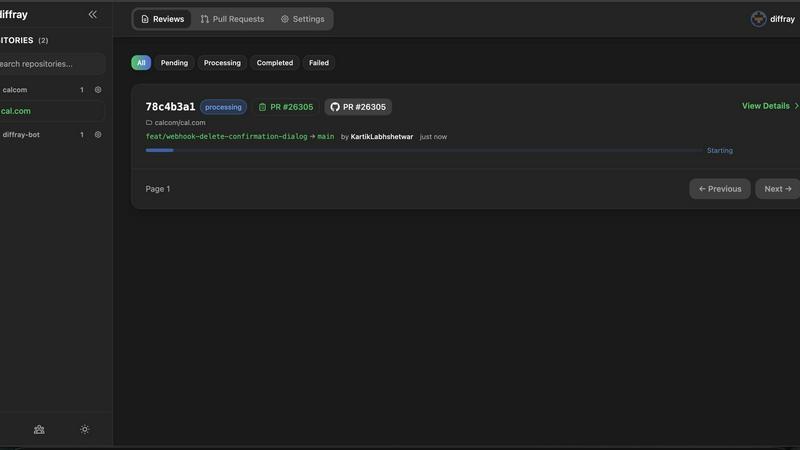
Diffray's multi-agent AI code review catches real bugs with 87% fewer false positives.
Last updated: February 28, 2026
Visual Comparison
Agenta
diffray
Feature Comparison
Agenta
Unified Playground & Experimentation
Agenta provides a centralized playground where teams can iterate on prompts and compare different models side-by-side in real-time. This model-agnostic environment eliminates vendor lock-in, allowing you to use the best model from any provider. With complete version history for every prompt change, teams can track iterations, revert if needed, and maintain a clear audit trail of their development process, turning chaotic experimentation into a structured workflow.
Automated & Comprehensive Evaluation
Move beyond vibe checks with Agenta's systematic evaluation framework. It enables you to create a rigorous process to run experiments, track results, and validate every change before deployment. The platform supports any evaluator, including LLM-as-a-judge, custom code, and built-in metrics. Crucially, you can evaluate the full trace of an agent's reasoning, not just the final output, and seamlessly integrate human feedback from domain experts into the evaluation workflow.
Production Observability & Debugging
Gain deep visibility into your live LLM applications with comprehensive tracing. Agenta captures every request, allowing you to pinpoint exact failure points when things go wrong. You can annotate traces with your team or gather feedback directly from end-users. A powerful feature lets you turn any problematic production trace into a test case with a single click, closing the feedback loop and enabling continuous improvement based on real-world data.
Cross-Functional Collaboration Hub
Agenta breaks down silos by bringing product managers, domain experts, and developers into one unified workflow. It provides a safe, UI-based environment for non-technical experts to edit and experiment with prompts without touching code. Everyone can run evaluations, compare experiments, and contribute to the development process directly from the UI, while full API and UI parity ensures seamless integration between programmatic and manual workflows.
diffray
Multi-Agent Specialized Architecture
Unlike generic AI reviewers, diffray's core power lies in its fleet of over 30 dedicated agents. Each agent is fine-tuned for a specific review category, such as detecting SQL injection flaws, optimizing database queries, identifying memory leaks, or enforcing React hooks rules. This division of labor ensures that feedback is exceptionally precise and context-aware, eliminating the blanket, often irrelevant suggestions common in other tools and providing developers with trustworthy, expert-level analysis.
Drastically Reduced False Positives
diffray is engineered for signal, not noise. By leveraging its specialized agents that understand the nuanced context of your code, the platform achieves an industry-leading 87% decrease in false positive alerts. This means developers spend virtually no time sifting through incorrect or trivial warnings, allowing them to focus exclusively on legitimate issues that impact security, performance, and stability, thereby increasing trust in the automated review process.
Context-Aware Project Intelligence
diffray doesn't just analyze code in isolation; it learns and adapts to your specific project. It understands your codebase structure, dependencies, and established patterns to provide tailored recommendations that align with your team's standards. This contextual awareness prevents generic advice and ensures that all suggestions are actionable and directly applicable to improving your particular repository, making the feedback immediately valuable.
Seamless GitHub Integration
Built for developer workflow efficiency, diffray integrates directly into GitHub, functioning as a powerful automated reviewer on every pull request. It posts detailed, categorized comments inline with the code diff, making it easy for developers to understand and address issues without switching contexts. This seamless integration works for both open-source projects and private enterprise repositories, fitting perfectly into existing CI/CD pipelines.
Use Cases
Agenta
Scaling Prototypes to Production
Teams with a working LLM prototype often struggle with the "last mile" to a reliable, scalable product. Agenta provides the structured workflow needed to systematically test, evaluate, and monitor changes. It replaces ad-hoc deployments with evidence-based releases, ensuring that performance improvements are real and regressions are caught early, dramatically increasing the success rate of launching AI features.
Centralizing Dispersed Prompt Management
When prompts are scattered across Slack, Google Sheets, and emails, consistency and version control are impossible. Agenta serves as the single source of truth for all prompt versions and configurations. This centralization prevents drift, allows for easy rollback, and ensures every team member is always working with the latest, approved iteration, eliminating costly errors and miscommunication.
Implementing Rigorous Evaluation Frameworks
For teams relying on manual "vibe testing," Agenta introduces a data-driven evaluation culture. You can build automated test suites that run against every proposed change, using LLM judges, code-based checks, and human-in-the-loop feedback. This creates a systematic gatekeeping process for production, building confidence that new prompts or model configurations actually improve key metrics before they impact users.
Debugging Complex Agentic Workflows
Debugging a failing LLM agent with multiple reasoning steps is notoriously difficult. Agenta's full-trace observability allows developers to see every intermediate step, input, and output. When an error occurs, engineers can drill down to the exact API call or reasoning step that failed, dramatically reducing mean-time-to-resolution (MTTR) and turning debugging from guesswork into a precise science.
diffray
Accelerating Pull Request Workflows for Scaling Startups
For fast-growing startups where engineering resources are precious, diffray acts as a force multiplier. It automates the initial, time-consuming pass of code review, catching critical bugs and security issues before human reviewers even look at the PR. This allows senior engineers to focus on architectural feedback and mentorship, dramatically speeding up merge times and enabling the team to ship features faster without compromising on code quality or security posture.
Enforcing Code Quality in Open Source Projects
Open-source maintainers often face a high volume of contributions with varying quality. diffray can be installed as a project guardian, automatically reviewing every incoming pull request against a standard of best practices, security, and performance. This ensures a consistent quality bar, educates new contributors with instant feedback, and significantly reduces the maintenance burden on core team members, helping projects scale sustainably.
Onboarding Junior Developers and Upskilling Teams
diffray serves as an always-available, expert mentor for junior developers. By providing immediate, educational feedback on code style, potential bugs, and best practices directly in their pull requests, it accelerates the learning curve and helps instill good habits from day one. For the entire team, it acts as a knowledge-sharing tool, consistently reinforcing standards and introducing advanced optimizations.
Enterprise Security and Compliance Guardrails
In regulated industries or large enterprises, diffray's specialized security agents provide an essential safety net. They automatically scan every commit for vulnerabilities like hard-coded secrets, injection flaws, and insecure configurations. This proactive, automated check integrates into the SDLC, helping teams meet compliance requirements and prevent security debts from being introduced into the codebase, thereby mitigating significant business risk.
Overview
About Agenta
Agenta is the open-source LLMOps platform engineered to transform how AI teams build and scale. It directly tackles the core chaos of modern AI development, where prompts are scattered across communication tools, teams operate in silos, and deployment is a leap of faith. Agenta provides the essential infrastructure to implement a structured, collaborative, and evidence-based workflow, serving as the single source of truth for developers, product managers, and subject matter experts. It is built for teams serious about moving fast without breaking things, enabling them to iterate smarter, validate thoroughly, and scale their LLM applications efficiently from fragile prototypes to robust, production-grade systems. By centralizing prompt management, automated evaluation, and comprehensive observability, Agenta empowers teams to replace guesswork with data-driven decisions, debug with precision, and ship reliable AI features with confidence.
About diffray
diffray is the next-generation AI code review assistant engineered to supercharge development velocity and code quality. It moves beyond the limitations of single-model AI tools by deploying a sophisticated multi-agent system. This architecture features over 30 specialized AI agents, each an expert in a distinct domain like security vulnerabilities, performance bottlenecks, bug patterns, and language-specific best practices. This targeted intelligence cuts through the noise, delivering hyper-relevant feedback that matters. The result is transformative for development teams: an 87% reduction in false positives and a 300% increase in catching genuine, critical issues. Built for scaling engineering teams who value precision and speed, diffray deeply understands your project's unique context and tech stack. It integrates directly into your existing GitHub workflow, providing actionable insights that empower developers to ship confidently. By transforming code review from a bottleneck into a seamless, automated gatekeeper, diffray helps teams reclaim precious time, slashing average weekly review efforts from 45 minutes to just 12 minutes and accelerating the path from commit to deploy.
Frequently Asked Questions
Agenta FAQ
Is Agenta really open-source?
Yes, Agenta is a fully open-source platform. You can dive into the code on GitHub, contribute to the project, and self-host the entire platform. This ensures transparency, avoids vendor lock-in, and allows for deep customization to fit your specific infrastructure and workflow needs.
How does Agenta handle collaboration for non-technical team members?
Agenta features a dedicated, user-friendly web interface that allows product managers and domain experts to participate directly in the LLM development lifecycle. They can safely edit prompts in a visual playground, set up and view evaluation results, and provide feedback on traces without writing a single line of code, fostering true cross-functional collaboration.
Can I use Agenta with my existing tech stack?
Absolutely. Agenta is designed to be framework and model-agnostic. It seamlessly integrates with popular frameworks like LangChain and LlamaIndex, and can work with models from any provider, including OpenAI, Anthropic, Azure, and open-source models. It complements your existing tools rather than forcing a replacement.
What is the difference between evaluation and observability in Agenta?
Evaluation in Agenta refers to the systematic, often automated, testing of LLM variants against predefined metrics and test sets before deployment. Observability is about monitoring live, production systems, capturing traces, and gathering real-user feedback to detect issues and regressions. Agenta connects both: a production issue (observability) can instantly become a test case (evaluation), closing the loop.
diffray FAQ
How does diffray's multi-agent system differ from a single AI model?
A single, general-purpose AI model tries to be a jack-of-all-trades, often leading to generic and noisy feedback. diffray's multi-agent system is like having a dedicated team of experts. Each of the 30+ agents is specifically trained and optimized for one area (e.g., Python security, frontend performance). This specialization allows for deeper, more accurate analysis in each domain, resulting in far more relevant and actionable insights with dramatically fewer false alarms.
What platforms and repositories does diffray support?
diffray is currently built for seamless integration with GitHub, supporting both GitHub Cloud and GitHub Enterprise Server. It can be installed on any repository within these platforms, including public open-source projects and private organizational repositories, making it versatile for individual developers, startups, and large enterprises alike.
How does diffray achieve such a high reduction in false positives?
The reduction is a direct result of our specialized agent architecture and context-aware analysis. Because each agent is an expert in its niche, it understands the subtle conditions that separate a real issue from a false alarm. Furthermore, diffray analyzes your project's specific context—like libraries used and existing code patterns—to filter out warnings that are not applicable, ensuring only high-confidence, relevant feedback is presented.
Is my code secure when using diffray?
Absolutely. diffray is designed with security as a foremost principle. The analysis is performed in a secure, isolated environment. We do not store your source code permanently, and we never use your proprietary code to train our general AI models. Your intellectual property remains yours, and the entire process is compliant with standard data security and privacy protocols expected by development teams.
Alternatives
Agenta Alternatives
Agenta is an open-source LLMOps platform designed to help teams build and scale reliable AI applications. It belongs to the rapidly evolving category of tools focused on managing the lifecycle of large language models, from experimentation to production. Teams often explore alternatives for various strategic reasons. These can include specific budget constraints, the need for different feature sets like deeper MLOps integration, or a requirement for a fully managed service versus an open-source framework. The right fit depends heavily on a team's existing tech stack, in-house expertise, and growth trajectory. When evaluating options, consider your core needs: a collaborative workflow for cross-functional teams, robust evaluation and testing capabilities to ensure quality, and comprehensive observability to debug and improve systems. The goal is to find a platform that provides structure without sacrificing the agility needed to innovate quickly in the AI space.
diffray Alternatives
diffray is a next-generation AI code review tool in the development category, designed to supercharge engineering velocity. It uses a multi-agent architecture to deliver precise, actionable feedback that cuts review time dramatically and reduces false positives by 87%. Teams often explore alternatives for various scaling needs. This could be due to budget constraints, specific feature requirements like support for niche languages, or the need for integration with a particular CI/CD platform or code hosting service beyond the mainstream. When evaluating other tools, prioritize solutions that offer deep codebase context, minimize noisy feedback, and integrate seamlessly into your existing workflow. The goal is to find a partner that scales with your team's growth, enhancing code quality without becoming a bottleneck.